
 Join our whatsapp group
 Join our Reddit group
 Reach the right audience.


Navigating the entrepreneurial landscape in a new country can be a challenging but rewarding journey. For Indian nationals with a dream of building a business in Germany, the Unternehmensgesellschaft (UG) offers an ideal starting point.
Often called the “Mini-GmbH,” this legal structure provides the benefits of limited liability with a minimal share capital, making it a low-risk gateway to entrepreneurship.
This detailed guide will walk you through the essential steps and specific requirements for registering a UG in Munich, from legal formalities to the final tax registration, complete with links to official government sources.
By following this guide, you will be well-prepared to successfully launch your business in Germany.
1. The Legal Framework: UG vs. GmbH
The UG is a variant of the GmbH (Gesellschaft mit beschränkter Haftung), Germany’s most common corporate form. The key difference is the share capital.
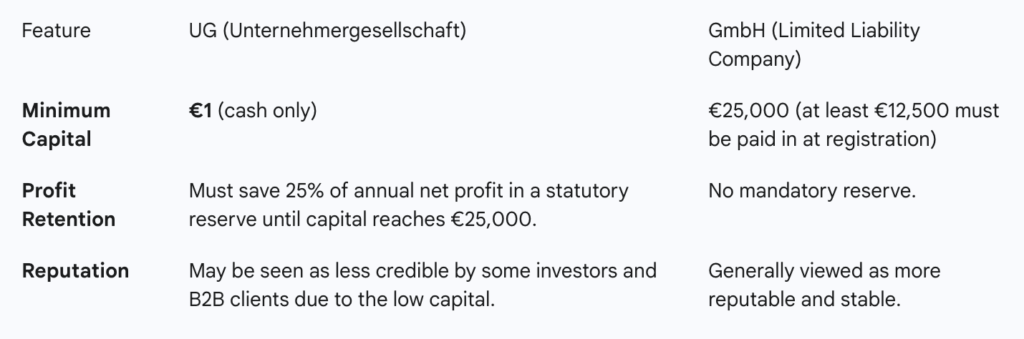
For an Indian national, starting with a UG is an excellent way to test a business idea with minimal financial risk, while still benefiting from limited liability. Once the statutory reserve reaches €25,000, you can convert your UG into a full GmbH.
For an Indian national, starting with a UG is an excellent way to test a business idea with minimal financial risk, while still benefiting from limited liability. Once the statutory reserve reaches €25,000, you can convert your UG into a full GmbH.
2. Pre-Formation Checklist for Indian Nationals
Before you begin the formal registration process, make sure you have the following in place:
- Valid Residence Permit: You must have a valid residence permit that allows for self-employment (
Aufenthaltserlaubnis zur Ausübung einer selbstständigen Tätigkeit). You must verify your visa status with the Foreigners’ Office (Ausländerbehörde). Without this, you cannot legally operate a business.- Official Source: Ausländerbehörde (Foreigners’ Office), Munich: https://stadt.muenchen.de/service/en-GB/info/auslaenderbehoerde/
- Business Plan: While not always required by law for registration, a robust business plan is essential for your visa application and for convincing potential investors or banks. It should detail your business idea, financial projections, and its positive impact on the German economy.
- Company Name & Business Activities: Choose a unique company name that is distinct from existing companies. The name must end with the legal suffix “UG (haftungsbeschränkt)”. You must also define the company’s objective or business activities. It is highly recommended to have your chosen name and business objective pre-approved by your local IHK (Chamber of Industry and Commerce).
- Official Source: IHK for Munich and Upper Bavaria: https://www.ihk-muenchen.de/ueber-uns/english-website/
3. Step-by-Step UG Registration Process in Munich
The formation process involves several legal and administrative steps that must be completed in a specific order.
Step 1: Notarization of the Articles of Association
This is the most critical step. German law requires all corporate formations to be notarized.
- Choose Your Articles: You have two options:
- Standard Articles (
Musterprotokoll): A pre-drafted, quicker, and less expensive option. This is only possible if your company has no more than three shareholders, one managing director, and a standard financial year. - Custom Articles (
Satzung): A more flexible but complex and expensive option for companies with more than three shareholders or more than one managing director.
- Standard Articles (
- Book a Notary Appointment: You and any co-founders must meet with a notary in Munich. The notary will draft and certify the articles, ensuring they comply with all legal requirements.
- Receive Notarized Documents: The notary will provide you with the notarized articles of association and other official documents.
Step 2: Open a Corporate Bank Account
After notarization, your UG is officially a “UG in formation.” The next step is to open a corporate bank account in the company’s name and deposit the share capital.
- Choose a Bank: Bring all your notarized documents and your passport. You can check with major banks like Commerzbank, Deutsche Bank, or online banks that specialize in business accounts.
- Deposit the Capital: Once the account is open, deposit the agreed-upon share capital (e.g., €1, €500, etc.). You will receive a deposit confirmation, which you must provide to the notary.
Read : How to Open a Bank Account in Germany
Step 3: Commercial Register Entry (Handelsregister)
Once the notary has confirmation of the deposited share capital, they will submit the application to the Commercial Register (Handelsregister) at the local court in Munich.
- Role of the Notary: The notary is responsible for electronically transmitting all documents to the court.
- Wait for Confirmation: The registration process can take several days to a few weeks. The UG’s official address must have the company name on the letterbox to receive the invoice for the register entry. Once the court approves the application, your UG will be officially registered and will receive a registration number (HRB-Nummer). You will also receive an invoice for the registration fee (approximately €300).
- Official Source: Joint Commercial Register Portal of the States: https://www.handelsregister.de/rp_web/welcome.do?act=start&lang=en
Step 4: Trade Registration (Gewerbeanmeldung) and Transparency Register
With your UG legally registered in the Commercial Register, you must now register your business with the local trade office (Gewerbeamt) and the Transparency Register.
- Required Documents: You will need your passport, residence permit, and an up-to-date excerpt from the Commercial Register.
- Submit Your Application: You can submit your application online or in person at the Gewerbeamt in Munich after booking an appointment. The registration fee is typically between €20 and €60.
- Official Source: Trade Office (Gewerbeamt) of the City of Munich: https://stadt.muenchen.de/service/en-GB/suche/trading/
- Register Beneficial Owners: As a legal entity, your UG must also be entered into the Transparency Register, where you will list the company’s beneficial owners.
- Receive Your Trade License: After successful registration, you will receive a Gewerbeschein (trade license), which officially allows your company to begin commercial operations.
Step 5: Register with the Tax Office (Finanzamt)
This is the final administrative step. The trade office will automatically notify the tax office (Finanzamt), but you must complete a separate questionnaire to receive your tax number.
- The
Fragebogen zur steuerlichen Erfassung: You will receive this comprehensive questionnaire in the mail or you can fill it out online via the ELSTER portal. It asks for detailed information about your company’s activities, expected turnover, and accounting method.- Official Source: ELSTER (Official German Tax Portal): https://www.elster.de/eportal/start
- Receive Your Tax ID: After submitting the form, the tax office will issue your company’s Steuernummer (tax number) and, if applicable, your Umsatzsteuer-Identifikationsnummer (VAT ID).
- Official Source: Munich Tax Office (Finanzamt): https://www.finanzamt.bayern.de/Muenchen/
Conclusion:
Registering a UG in Munich is a multi-step process, but it is a manageable one with the right preparation. By securing your valid residence permit, carefully preparing your business plan, and following the formal steps from notarization to tax registration, you can successfully establish your company.
The UG’s low capital requirement makes it an excellent choice for Indian entrepreneurs looking to test the waters and build a foundation for future growth in Germany’s dynamic business environment.
Now that you have this roadmap, you are ready to take the next step toward making your entrepreneurial vision a reality.
If this article helped you, consider buying us a coffee to keep the lights on. Support Munich Indians on Ko-fi

Leave a Comment
Your email address will not be published. Required fields are marked*